
Shanghai Pudong Prosperity Alliance Climate Week Research Institute Inaugurated in Expo Qiantan: Building a New Hub for Global Climate Action
On April 13, 2026, the Shanghai Pudong Prosperity Alliance Climate Week Research Institute (hereinafter referred to as the "Institute") was officially inaugurated in Expo Qiantan. As a non-profit research and action platform dedicated to global climate governance and green transformation, this establishment marks a critical milestone in Pudong's commitment to climate governance and sustainable development, while simultaneously providing a new institutional vehicle for China to deepen its engagement in the global climate agenda.
The Institute operates as a foreign-related non-governmental organization, established under the guidance of the China (Shanghai) Pilot Free Trade Zone Expo Administration, and approved by the Shanghai Municipal Civil Affairs Bureau and the Pudong New Area Civil Affairs Bureau. It was co-founded by the Shanghai Key Laboratory of Urban Design and Urban Science (hereinafter referred to as the "LOUD "), Shanghai Climate Week, and the United Nations Institute for Training and Research (UNITAR) Prosperity Alliance. Professor Guan Chenghe, Co-Founding Director of the LOUD, serves as the Chairman of the Board.
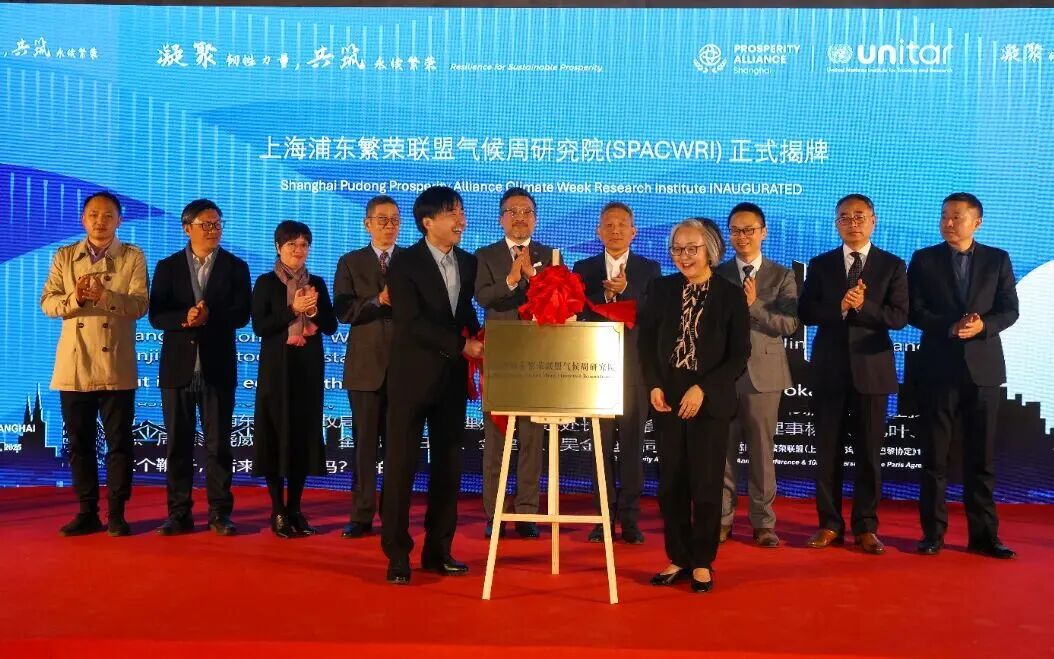
[Figure: Professor Guan Chenghe, Co-Founding Director of the LOUD, and Ms. Mihoko Kumamoto, Director of the Division for Prosperity at UNITAR, unveiling the plaque for the Shanghai Pudong Prosperity Alliance Climate Week Research Institute.]
From its inception, the Institute has clearly defined its international mandate: to remain rooted in Pudong while connecting globally. By focusing on climate change and sustainable development, it aims to construct a comprehensive platform that integrates research, translation, collaboration, and action.
In the current landscape of climate governance, scientific breakthroughs alone are insufficient to sustain complex systemic transformations. The establishment of the Climate Week Research Institute is a direct response to three structural challenges within the current framework: first, the disconnect between research outcomes and practical application, where a substantial volume of frontier findings fails to materialize into actionable urban and industrial solutions; second, the inadequacy of technology translation and industrial deployment, with green technologies frequently remaining confined to laboratory settings; and third, the weakness in international coordination and standardization, characterized by a lack of mutually recognized and scalable regulatory systems across diverse nations and regions.
Addressing these issues, the Institute aspires to build a "globally connected, practice-oriented, and system-driven" hub for climate action, endeavoring to bridge the entire chain from knowledge production to tangible real-world implementation.
Distinguishing itself from traditional research institutions, the Institute prioritizes "executability." Its core functions operate across four dimensions:
first, scientific translation and innovative deployment. By leveraging the research foundation of the LOUD and other entities, it seeks to advance frontier outcomes—such as the "Climate Urban Park"—from conceptualization to practical implementation within urban spaces, creating replicable and scalable public goods.
Second, policy empowerment and regional development support. In alignment with the integration of the Yangtze River Delta and the development of the Pudong Leading Area, the Institute will provide data-driven tools and decision-making support to explore low-carbon pathways for urban clusters, thereby serving as a demonstrative model for the nation.
Third, global collaboration and standard dissemination. Utilizing international platforms such as UNITAR and New York University Shanghai, it aims to translate China’s practical experiences in green development into globally comprehensible and adoptable standards and pathways, thereby enhancing China’s capacity to participate in the formation of international climate governance rules.
Regarding its operational layout, the Institute exhibits clear characteristics of a "platform-based organization," encompassing multiple critical domains, including research on climate and sustainable development standards, capacity building and training systems, international exchange and communication, policy consultation and evaluation research, and technology translation and industrial innovation demonstration. This underscores the Institute's role not merely as a research body, but as a hub connecting governments, enterprises, and international organizations. Whether addressing urban low-carbon transformation, corporate carbon management, or green finance and climate investment, the platform provides systematic support across the board.
The establishment of the Institute in Expo Qiantan is not only a significant milestone for the LOUD in 2026 but also a critical instrument for Pudong to cultivate a highland for international climate governance and green, low-carbon development, further reinforcing its leading role in institutional innovation and open cooperation. For China, it serves as a vital fulcrum for participation in the formulation of global climate rules, facilitating the elevation of domestic practices into international standards and enhancing the nation’s influence in global climate discourse.
- 57 views