
LOUD Undergraduate Student Awarded Major Honors
Recently, Ziyan (Nadine) Chen, a Class of 2026 undergraduate student majoring in Urban Studies and a Research Assistant at the Shanghai Key Laboratory of Urban Design and Urban Science (LOUD), was awarded "Major Honors" by the Division of Arts and Sciences. This prestigious honors degree is conferred upon students who successfully complete advanced professional honors coursework while maintaining outstanding academic standing. Upon graduation, Ms. Chen will pursue a Master’s degree in Learning Design, Innovation, and Technology at Harvard University. Grounded in the theoretical frameworks of learning sciences and educational innovation, Nadine hopes to integrate her background in urban studies to examine how learning environments and urban spatial structures condition individual development opportunities, aiming to cultivate more inclusive and equitable learning environments that facilitate the integration and advancement of diverse communities within the urban matrix.
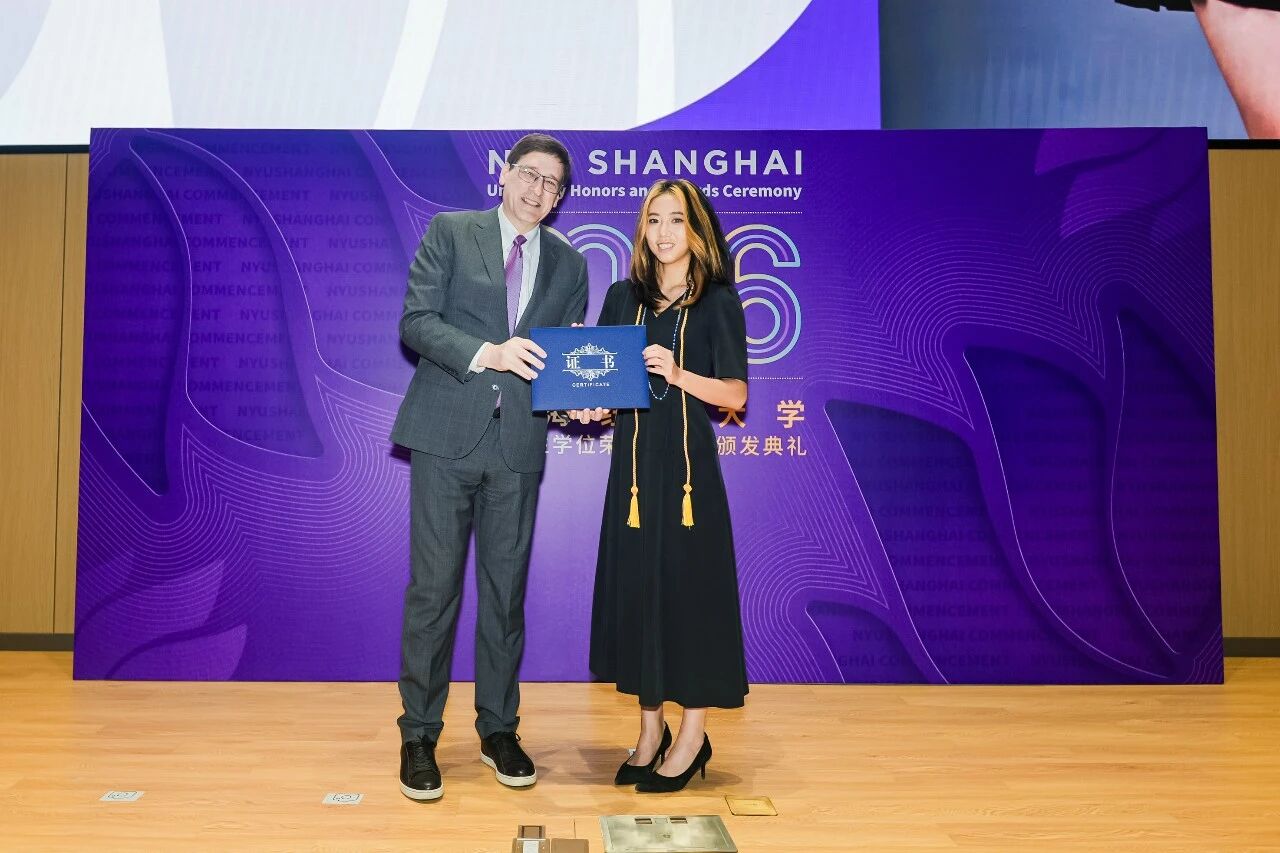
Professor David AtWill, Dean of Arts and Sciences at NYU Shanghai, Presenting the Award to Ziyan Chen
During her undergraduate career, Ms. Chen studied courses including Urbanization in China, Urban and Architectural Design, and Planning Global Cities under the mentorship of Professor ChengHe Guan and Professor Ying Li, Co-Founding Directors of the LOUD Laboratory. Her research project, titled Assessing Urban Health in College Students: The Benefits that Exercise Brings, was supported by the LOUD Laboratory Undergraduate Research Grant under the Open Topic Grants program.
Leveraging her academic strengths, Ms. Chen’s research examines the relationship between the accessibility of campus sports facilities, collegiate athletic behavior, and physical well-being. Using Songjiang University Town and Wujiaochang University Town in Shanghai as case studies, her work integrates questionnaire surveys with GIS spatial analysis. She utilized QGIS to perform spatial annotations and extract geographical coordinates for academic buildings, dormitories, and sports facilities across universities. Subsequently, by deploying walking route APIs, she calculated the pedestrian travel times and distances from diverse campus nodes to sports facilities to construct comprehensive accessibility metrics, systematically analyzing the spatial distribution and pedestrian accessibility of athletic resources across campuses and their subsequent impacts on students' exercise frequencies. The empirical findings reveal that the accessibility of sports facilities exhibits pronounced disparities across different universities and university towns. Furthermore, compared to mere physical proximity, the aggregate volume of accessible sports resources and the degree of spatial convenience within the campus environment demonstrate a stronger explanatory power regarding variations in students' exercise frequencies.
- 84 views