
Land Use Restrictiveness and Mortgage Access: How Regulatory Environments Condition Racial and Income Disparities in Loan Approvals and Pricing
How do urban planning systems influence mortgage approval rates and interest rate pricing across diverse socioeconomic and racial groups, such as high- versus low-income earners and Black versus White applicants? In what ways do land use regulatory frameworks shape the spatial patterns of urban residential areas? Published in the Journal of the American Planning Association, a flagship journal in the field of urban planning, this study systematically unveils how land use regulations condition housing loan outcomes for different racial and income groups, offering a novel paradigm for understanding the nexus between urban planning and housing finance.
Exclusionary zoning represents a primary manifestation of land use regulations, whereby local governments influence the affordability, diversity, and accessibility of housing supply through mechanisms such as prescribing minimum lot sizes, restricting multi-family residential developments, and erecting procedural barriers to development. Against the backdrop of global urban initiatives advancing housing equity and planning reforms, exclusionary zoning has long been identified as a critical driver exacerbating housing shortages and reinforcing racial and income segregation. Nevertheless, a systemic gap remains in academic literature regarding how land use restrictions further permeate the housing finance market, particularly concerning inequalities within loan approval and pricing processes.
Mortgage loans serve as a vital conduit for residents to secure housing, accumulate wealth, and enter high-opportunity neighborhoods, acting as a crucial mechanism that shapes the spatial distribution of urban populations and social stratification. While an extensive body of historical scholarship has separately scrutinized exclusionary zoning policies and mortgage discrimination, the interplay between the two has long been overlooked. In practice, land use regulations not only dictate the typologies of housing permitted for construction but also modulate property values, collateral assets, and financial institutions' evaluations of market risk, thereby subtly conditioning loan approval outcomes and financing terms.
To address this empirical gap, this study constructed a comprehensive analytical database covering multiple metropolitan areas across the United States. The dataset integrates over 2.09 million residential mortgage loan applications spanning 2018 to 2020 from the Home Mortgage Disclosure Act (HMDA) with the Wharton Residential Land Use Regulatory Index (WRLURI). Utilizing logistic regression models and ordinary least squares (OLS) regression models, the research systematically analyzes the relationships between land use restrictiveness, applicant race, income levels, mortgage approval outcomes, and interest rates.
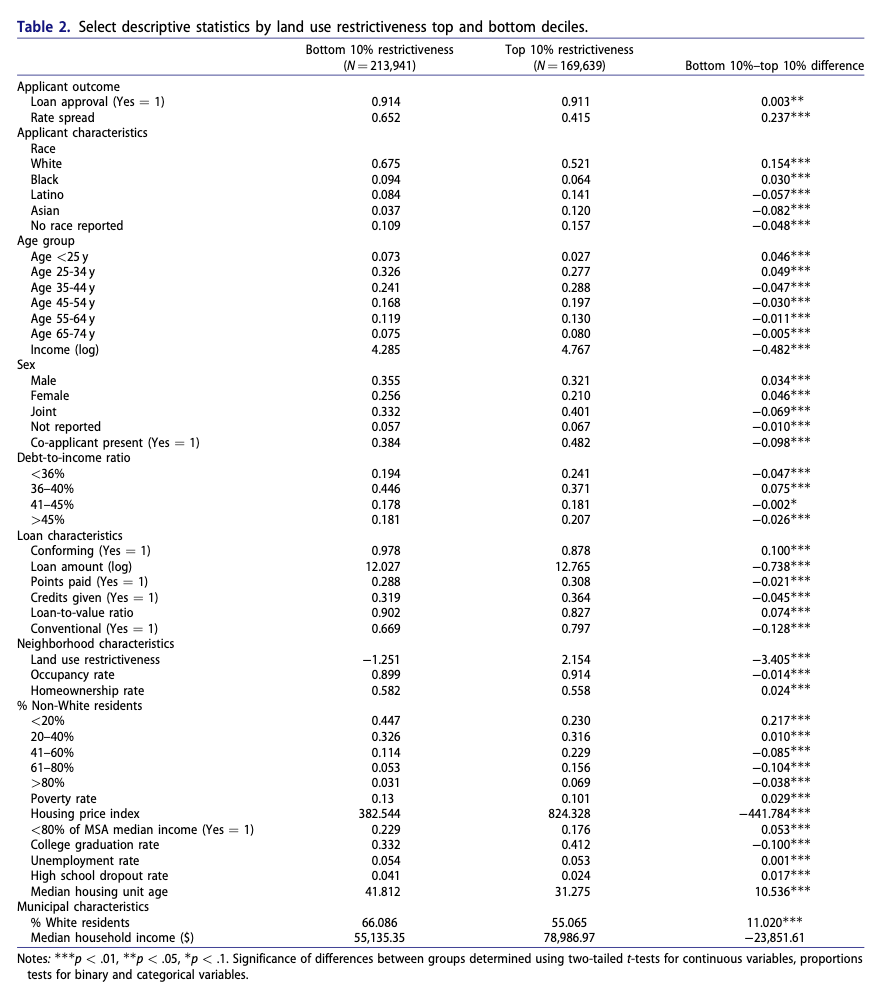
Table: Comparison of Key Descriptive Statistical Characteristics Between the Top 10% Most Restrictive and Bottom 10% Least Restrictive Land Use Areas
The core findings of this study include:
-
The loan approval gap between Black and White applicants narrows in highly regulated land use environments. The study indicates that in cities with the highest levels of land use restrictiveness, the disparity in mortgage approvals between Black and White applicants is mitigated. Although the aggregate approval rate for Black applicants consistently tracks below that of White applicants, this discrepancy is significantly attenuated in highly restrictive jurisdictions. The study posits that this phenomenon may be attributed to elevated property values, more stabilized housing markets, and the development of certain high-income Black neighborhoods within these highly regulated areas. This outcome demonstrates that land use regulations do not impact all groups uniformly; rather, their operational mechanisms exhibit pronounced spatial heterogeneity and context dependency.
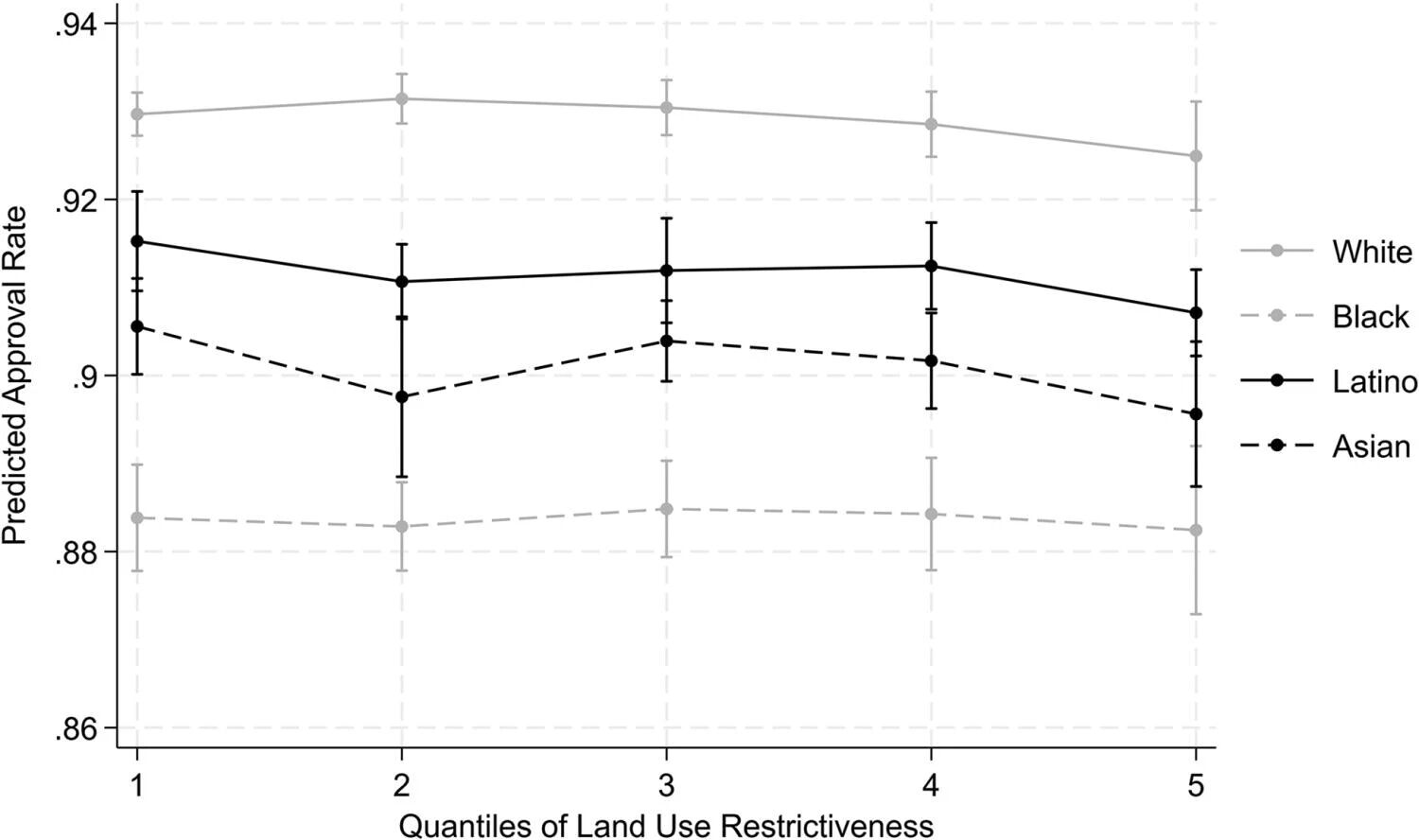
Figure 1: Predicted Mortgage Approval Rates by Race Across Varying Levels of Land Use Restrictiveness
-
The mortgage advantage typically held by high-income populations diminishes in cities with strict land use regulations. Diverging from conventional assumptions, the study reveals that stringent land use regulations do not exclusively favor high-income cohorts. In the most restrictive cities, the mortgage approval premium enjoyed by high-income applicants steadily declines, with their probability of approval falling below that of certain moderate-income groups. Concurrently, high-income borrowers in these jurisdictions frequently incur higher loan interest rates. The empirical evidence indicates that as land use constraints intensify, the financial advantages conferred by income are substantially eroded. This finding challenges the traditional thesis that rigid zoning primarily serves high-income households, revealing a far more intricate interaction between land use regimes and housing finance.
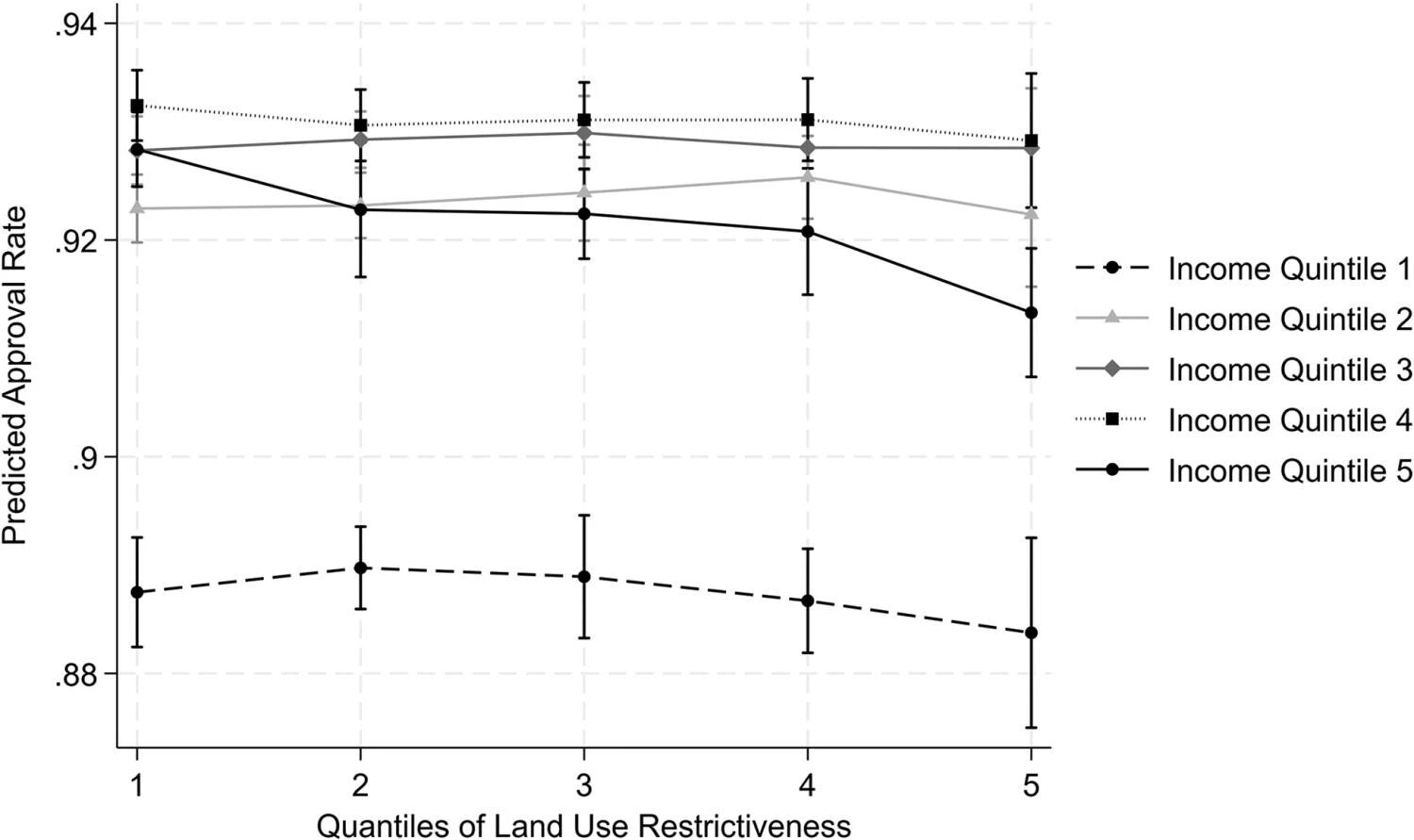
Figure 2: Predicted Approval Rates across Income Groups and Levels of Land Use Restrictiveness
-
Land use restrictiveness does not alter racial disparities in interest rates but escalates loan pricing for high-income groups. The analysis reveals that land use regulations exert no statistically significant moderating effect on the interest rate differentials between different racial groups. In other words, the pricing gap between Black and White borrowers remains virtually unaltered regardless of the degree of land use restrictiveness. However, in regions characterized by more stringent land use controls, high-income borrowers who successfully secure approvals tend to face higher interest rate spreads. This finding aligns with the observed erosion of the high-income approval premium in restrictive environments, indicating that strict regulatory contexts affect not only loan accessibility but also the underlying cost of capital. The study further underscores that land use policies influence more than just housing supply and neighborhood composition; they actively shape how financial institutions assess collateral values and market risks.
Consequently, urban planning and housing finance do not operate as isolated systems; rather, they function as conjoined institutional forces that actively dictate the socio-spatial matrix of contemporary cities. Disparities within the mortgage approval process are, to a large extent, structurally embedded within the market environments engineered by local planning regimes. As numerous states across the U.S. actively pursue zoning reforms to expand housing supply, this research demonstrates that land use deregulation concerns not only housing construction but also the equitable distribution of housing finance opportunities.
The insights generated by this research suggest that future planning policies must look beyond merely increasing the volume of housing supply and turn their attention to how financial resources are allocated across diverse demographic groups. Only by integrating land use reforms with equitable housing finance policies can cities genuinely foster equality of opportunity and social integration. This study expands the theoretical boundaries of scholarship regarding exclusionary zoning and housing inequality while providing a robust explanatory framework for understanding racial and income disparities within the housing finance market. For the advancement of more equitable, inclusive, and sustainable urban development, understanding how urban planning systems allocate financial opportunities holds profound theoretical value and practical significance.
This study was authored by Professor Tyler Haupert at the Shanghai Key Laboratory of Urban Design and Urban Science (LOUD). This research was supported by the Open Topic Grants from the Shanghai Key Laboratory of Urban Design and Urban Science.
Article Citation
Haupert, T. (2026). Land Use Restrictiveness and Mortgage Access: How Regulatory Environments Condition Racial and Income Disparities in Loan Approvals and Pricing. Journal of the American Planning Association, 1–16. https://doi.org/10.1080/01944363.2026.2647145
- 158 views