
Informal Settlement Demolition Cools Land by 1.5 Degrees, but Indigenous Residents Formally Driven to Urban Peripheries
Editor’s Note
Professor Kangning Huang from the Shanghai Key Laboratory of Urban Design and Urban Science (LOUD) has published a study on urban cooling in npj Environmental Social Sciences.
The following article is from Counter-Intuitive Notes. Author: Kangning Huang
A 1.3-Billion-Dollar Tuition Fee
1.3 billion dollars.
This is the astronomical sum burned annually by a US anti-drug education program named DARE during its peak operational years.
The programmatic premise appeared entirely rational: deployed uniformed police officers entered classrooms to educate children on the perils of narcotics. An early evaluation indicated that children participating in these sessions exhibited a drug abuse rate 40% lower than those who did not. First Lady Nancy Reagan personally endorsed the initiative, which was subsequently adopted by 75% of school districts across the United States, reaching 26 million students annually.
However, that initial evaluation overlooked a critical confounding bias. Parents who voluntarily enrolled their children in anti-drug courses were inherently more attentive to their children's well-being; similarly, students capable of remaining compliant throughout the 17-week curriculum were inherently more self-regulated. Conversely, adolescents more predisposed to deviance and substance abuse had likely dropped out of school prematurely, completely precluding their exposure to DARE’s interventions.
The correlation was genuine. The causal inference, however, was fundamentally flawed.
It was not until 1999 that a research team tracked approximately 1,000 students—including both a treatment group exposed to DARE and a non-exposed control group—following them until the age of twenty [1]. A decade later, the findings revealed that actual substance use behaviors, attitudes toward narcotics, and self-esteem levels between the two cohorts were virtually identical.
This billion-dollar expenditure yielded zero empirical efficacy; youth inherently predisposed to drug use persisted in substance abuse post-DARE intervention.
Why Establishing Causal Links Remains Elusive
This underscores one of the most painful epistemological lessons in social science. Scholars later formulated a robust methodology to counter such biases: the Randomized Controlled Trial (RCT). By randomly assigning subjects into two groups—one receiving the intervention and the other serving as a control—the baseline characteristics of both cohorts are rendered probabilistically identical. Variations in intelligence, obedience, or rebellion are randomly dispersed. Consequently, any observed divergence between the two groups can be uniquely attributed to the intervention itself. This constitutes the most reliable methodology for causal inference.
Nevertheless, executing randomized controlled trials within the domain of urban governance remains highly impractical. It is impossible to toss a coin to determine which municipalities receive canopy planting, nor can one compel a population of one million to reside within an intentionally heated urban matrix to serve as a control group.
Consider the query: "Can the demolition of urban villages (informal settlements) in China effectively induce local cooling?" Over the past decade, published literature has yielded diametrically contradictory conclusions, with some studies reporting a 5-degree temperature reduction and others observing a 3-degree escalation. The empirical data utilized in each instance were valid; the fundamental limitation resided in the lack of methodological rigor. These studies predominantly relied on either "pre- versus post-demolition" longitudinal comparisons or "demolished versus non-demolished" cross-sectional comparisons. Neither approach could disentangle the true treatment effects of demolition from broader temporal and spatial externalities.
Temporal (pre-post) comparisons fail to isolate systemic background climate shifts. Over the past two decades, macro-scale global temperatures have consistently escalated, and the overarching urban matrix has warmed due to continuous horizontal expansion and vertical densification. Even if a specific demolition intervention theoretically cooled a parcel by 2 degrees, a background temperature surge of 3 degrees would ultimately render the post-demolition site hotter than its baseline state.
Cross-sectional (demolished versus non-demolished) comparisons fail to account for spatial location bias. Urban villages selected for demolition are predominantly situated within dense, central core areas that inherently exhibit elevated thermal profiles prior to intervention. Empirical data indicates that prior to demolition, the mean land surface temperature of targeted parcels was 312.7 K, compared to 311.6 K for control parcels—a baseline disparity of 1 Kelvin. While demolition alters the physical density and vegetation cover of a specific site, it cannot modify its geographic position within the wider urban hierarchy. Direct comparisons between demolished and non-demolished parcels convolute the thermal variance induced by the intervention with pre-existing spatial discrepancies, rendering them mathematically inseparable.
Two Pedestrians Walking Parallel
To address these methodological limitations, my co-authors and I attempted a more rigorous re-analysis of this phenomenon, deploying a specialized econometric tool designed for causal inference: the Difference-in-Differences (DID) framework.
To intuitively understand the DID mechanism, imagine a coordinate system where the horizontal axis denotes the temporal dimension (years) and the vertical axis represents Land Surface Temperature (LST). Two distinct trajectories depict two urban villages within the metropolitan matrix.
These trajectories do not intersect. One trajectory consistently exhibits a higher thermal baseline due to its core location. However, despite this baseline divergence, the two trajectories remain strictly parallel over time. Hotter years induce parallel temperature spikes across both sites, while cooler years elicit symmetrical reductions; the vertical distance between them remains constant across decades.
They behave like two pedestrians walking side-by-side, perpetually separated by a fixed spatial interval.
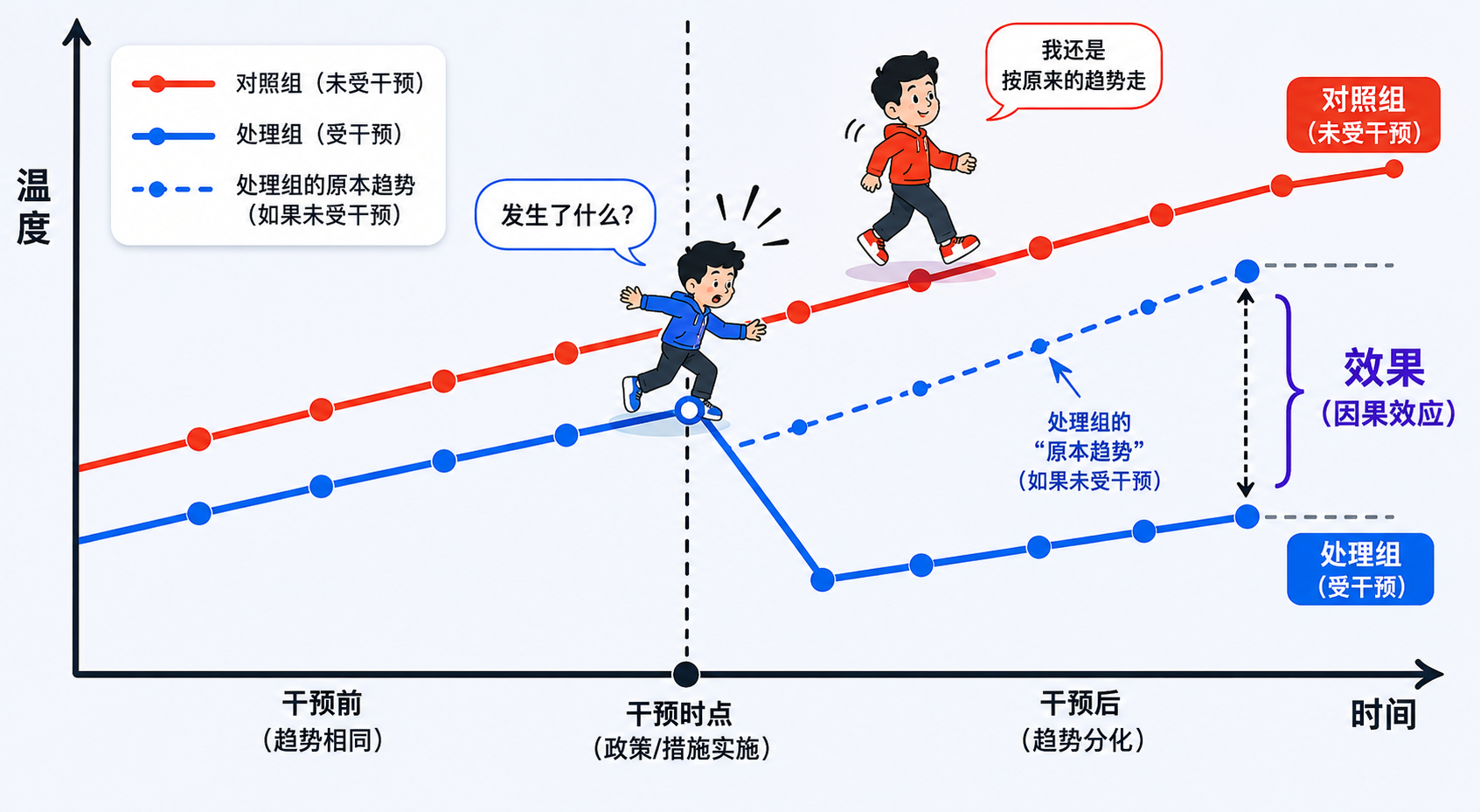
Then, in a specific year, one of the urban villages is demolished.
The trajectory of the demolished site abruptly drops. Meanwhile, the control trajectory continues along its historical path, unaffected. The vertical distance between the two trajectories shifts from the historical baseline value to a new, substantially larger margin.
This incremental divergence represents the true urban cooling effect causally induced by the demolition intervention.
By translating this intuitive understanding into formal mathematical equations, the exact magnitude of the cooling effect can be isolated.
The Cooled Parcel
Leveraging two decades of Landsat satellite thermal infrared imagery, we tracked 77 demolished urban villages across Beijing, Shanghai, and Guangzhou, utilizing 584 non-demolished urban villages as a rigorous control group.
Aggregating all samples, the demolition interventions causally induced a land surface cooling effect of approximately 1.5 degrees Celsius. While a 1.5-degree variance might appear modest, it precisely mirrors the critical target threshold that global nations are striving to maintain under the Paris Agreement. Yet here, this magnitude of cooling was achieved locally on a single parcel through demolition.
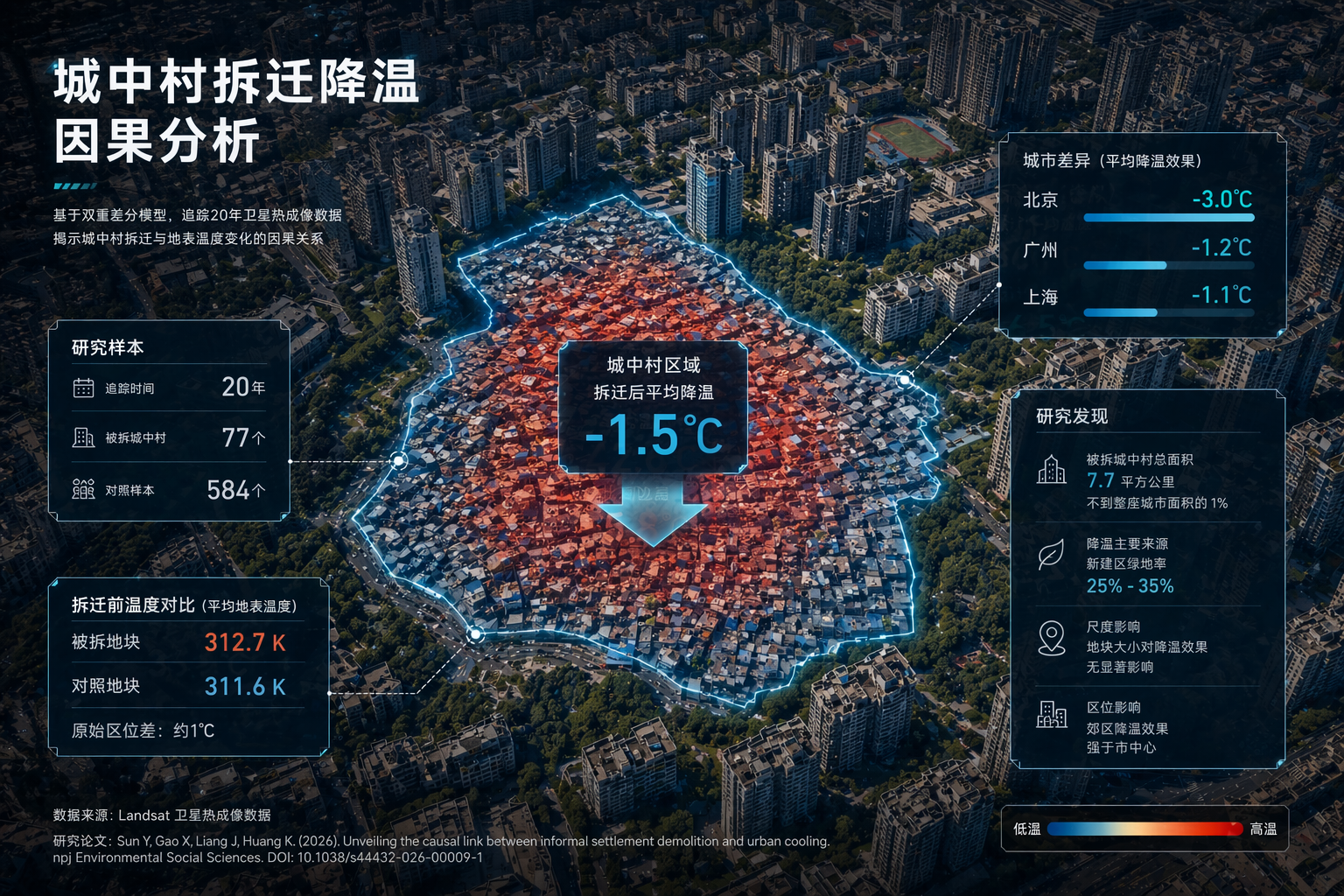
However, the cooling efficacy exhibited significant heterogeneity across the three metropolises: Beijing recorded a temperature reduction of 3 degrees, whereas Guangzhou and Shanghai exhibited declines of 1.2 degrees and 1.1 degrees, respectively. The cooling magnitude increases with regional aridity. In arid climates, newly integrated green spaces effectively drive thermal reduction via evapotranspiration; conversely, in humid microclimates where atmospheric moisture approaches saturation, additional vegetation cannot optimize evapotranspiration to achieve equivalent cooling performance.
Furthermore, an unexpected institutional driver was discovered within Beijing’s cooling trajectory. Chinese urban planning regulations mandate that newly constructed residential developments must guarantee a minimum of one hour of continuous sunshine on the winter solstice. This regulatory constraint necessitates significantly larger building separation distances in higher-latitude municipalities, inadvertently allocating substantial ground space for ecological landscaping. Consequently, a regulatory framework seemingly decoupled from microclimate management emerged, two decades later, as the explanatory driver for why Beijing achieved a cooling effect 2 degrees greater than Shanghai.
What did these parcels transform into post-demolition? The vast majority were redeveloped into formalized residential and commercial complexes, while only a marginal fraction was zoned as public parks. The primary driver of the observed localized cooling was the structural enforcement of modern building codes: newly constructed buildings are legally mandated to comply with a green plot ratio of 25% to 35%. These legally enforced open spaces constitute the physical source of the cooling effect.
Who Truly Benefits from This Microclimatic Relief?
While the DID framework successfully resolves the inquiry of whether "demolition induces local cooling," answering in the affirmative, it remains incapable of addressing the subsequent question: upon whom does this microclimatic benefit descend?
A parallel study conducted in Hangzhou tracked this exact socioeconomic trajectory. Following the demolition of urban villages, 29.2% of migrant workers were compelled to allocate over 30% of their monthly income strictly toward housing rent, while 14.1% were forced to permanently migrate back to their rural hometowns. Hundreds of thousands of individuals who previously resided proximate to their employment hubs within affordable housing frameworks were structurally dispossessed of their affordable accommodations.
The newly constructed residential complexes command a baseline monthly rent starting at 6,000 RMB. Those who successfully transition into these spaces are predominantly entry-level corporate white-collar professionals. Conversely, the displaced populations—the original residents of the urban villages who previously commuted thirty minutes by electric bicycle to construction sites—are excluded. A subset of this demographic relocated to distant peri-urban fringes, while others exited the metropolitan market entirely to return to their ancestral villages.
The land surface temperature of the vacated parcel indeed decreased by 1.5 degrees. However, although mathematically identical, a 1.5-degree physical variance translates into vastly divergent physiological experiences when conditioned by socioeconomic status. For occupants of newly engineered apartments featuring advanced thermal insulation, optimal ventilation, and affordable air conditioning, this 1.5-degree reduction constitutes a tangible enhancement in well-being. For individuals confined to the dense, poorly ventilated "handshake buildings" of informal settlements relying solely on electric fans to endure summer heatwaves, this physical variance remains imperceptible. The capacity to inhabit a thermally optimized structure is inherently bound to household income.
Our instruments quantified land surface temperature, not human thermal comfort.
We proved the physical cooling of the parcel; we could not prove that the displaced population experienced a cooler life. Empirical evidence suggests that many have been systematically displaced to more vulnerable environments.
An entire metropolis can exhibit a downward thermal trajectory, yet the most heat-vulnerable populations are being pushed further to the urban periphery.
In the future, whenever an assertion posits that "because X causes Y, we must execute more of X"—
You must raise two critical inquiries. First: How do you establish that X is the true causal driver of Y? The second inquiry is far more challenging, yet profoundly more critical: Even if X is conclusively proven as the cause, who genuinely captures the benefits of outcome Y?
A 1.5-degree cooling effect is a physical fact. Discerning who experiences that cooling is a moral imperative.
The urban village demolition study introduced in this article has been published in npj Environmental Social Sciences:
Sun, Y., Gao, X., Liang, J., & Huang, K. (2026). Unveiling the causal link between informal settlement demolition and urban cooling. npj Environmental Social Sciences, 1–16. https://www.nature.com/articles/s44432-026-00009-1
The annual cooling trajectories of the 77 demolished urban villages across the three target cities can be explored via this interactive visualization platform: https://kangning-huang.github.io/urban-renewal-cooling-DID/
References
[1] Lynam, D. R., Milich, R., Zimmerman, R., et al. (1999). Project DARE: No effects at 10-year follow-up. Journal of Consulting and Clinical Psychology, 67(4), 590–593.
- 135 views