
GreenMove: Constructing a dataset for public green spaces in Shanghai
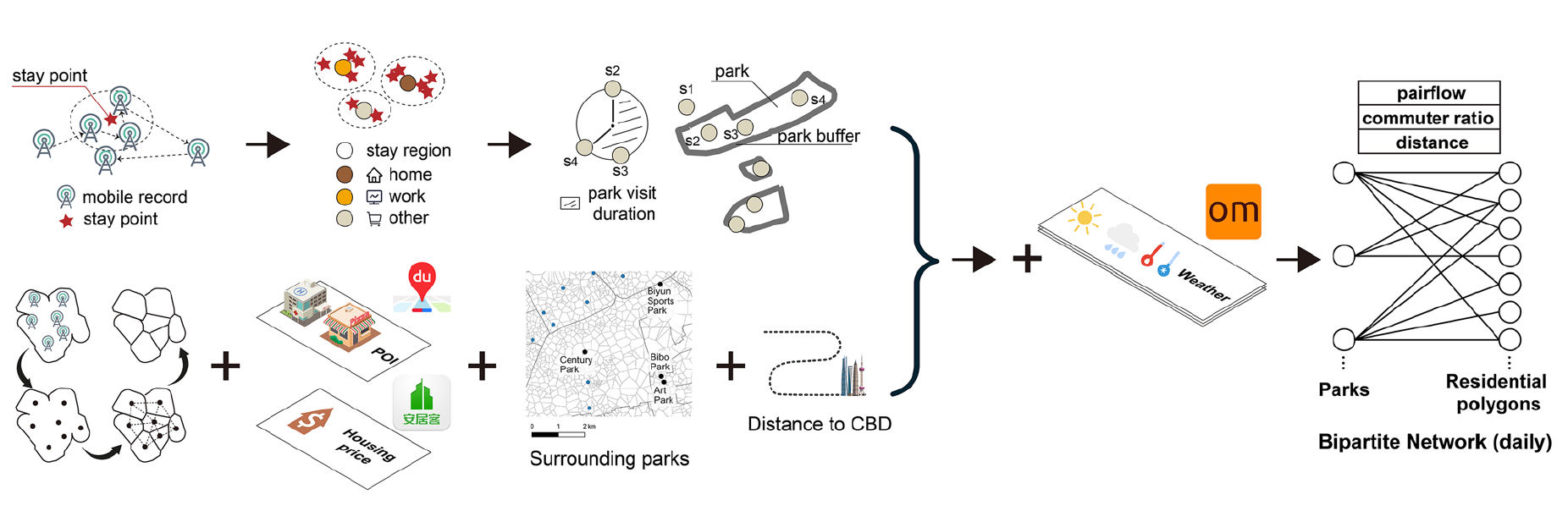 Fig. A schematic overview of the study.
Urban green space research continues to thrive, increasingly adopting data-driven approaches. Leveraging anonymized mobile phone data from 10 million users in Shanghai, this study tracks park visitations over a four-month period and develop GreenMove - a real, population-level, daily dynamic mobility network that maps the connections between residential polygons and parks.
These connections are enriched with meaningful metrics such as visitation flow, commuter ratios, and spatial distance between nodes. By modeling the interactions between residential areas and parks, GreenMove helps bridge the "demand-supply" gap, offering quantifiable insights into park demand and attractiveness. In addition to accounting for the geographical features and competitive dynamics among parks, the network integrates a wide range of consistent socioeconomic indicators and fine-grained weather data. GreenMove acts as a dynamic framework that captures residents’ use of green spaces and supports deeper, multidimensional analyses for advancing urban park research and promoting equity in planning. It also provides a valuable temporal baseline for tracking how cities evolve over time and for understanding the shifting patterns of park accessibility, laying the groundwork for future innovations in sustainable urban design.
The Shanghai Key Laboratory of Urban Design and Urban Science (LOUD), in collaboration with the MoE Key Laboratory of Artificial Intelligence at the AI Institute, Shanghai Jiao Tong University, constructed this real population-level daily dynamic mobility network. The research, titled “Dataset for Visitations of Public Green Spaces in Shanghai, China”, has been published in Scientific Data, a Nature Portfolio journal.
The research is supported and funded by the Shanghai Big Data Center, the Shanghai Nature and Health Foundation, the Shanghai Municipal Education Commission (Key program of AI-Driven Initiative to Promote Research Paradigm Reform and Empower Disciplinary Advancement), and Envision Energy.
Citation:
Feng, Y., Huang, S., Chen, S., Guan, C., Li, Y., Tan, Q., Jin, Y., Yang, X., & Xu, Y. (2025). Dataset for visitations of public green spaces in Shanghai, China. Scientific Data, 12(1260). https://doi.org/10.1038/s41597-025-05581-w
- 42 views