
Generational differences in active travel: Estimation, decomposition, and policy implications
In rapidly developing cities such as Chengdu, why do younger generations demonstrate a higher propensity for driving, whereas middle-aged and older cohorts favor walking and cycling? The disparity in modal choices across age groups is profound and stems not merely from individual preferences, but from the complex interplay of urban developmental stages and residential environments. Published in Applied Geography, this study utilizes Chengdu as a case study to uncover the deep-seated mechanisms through which generational differences influence active travel, thereby offering a fresh perspective for sustainable urban transport planning.
Active travel, encompassing non-motorized transport modes such as walking and cycling, serves as a hallmark of low-carbon, healthy cities and a vital pathway for mitigating traffic congestion and reducing transport-related emissions. While the global imperative to decarbonize transportation has prompted extensive research into the nexus between urban development and travel behavior, the interactions between urban evolution and intergenerational shifts in active travel remain under-explored. Cohorts raised in vastly different urban motorization environments have cultivated relatively stable mobility habits. Distinguishing whether these disparities arise from age-dependent life-cycle effects or from enduring characteristics unique to a specific generation—the cohort effect—is pivotal for driving a sustainable transport transition.
Using survey data from 1,048 residents in Chengdu (2016), the study constructs a Structural Equation Model (SEM) and employs standardization and decomposition analyses to systematically examine how socioeconomic conditions, travel perceptions, and residential environments collectively shape commuter choices across different age groups, providing the first clear differentiation between life-cycle and cohort effects on active travel.
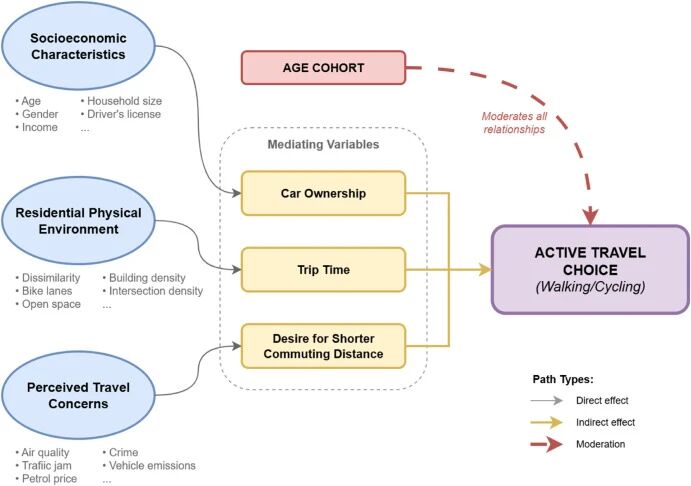
Figure 1. Conceptual framework of intergenerational differences in active travel choices.
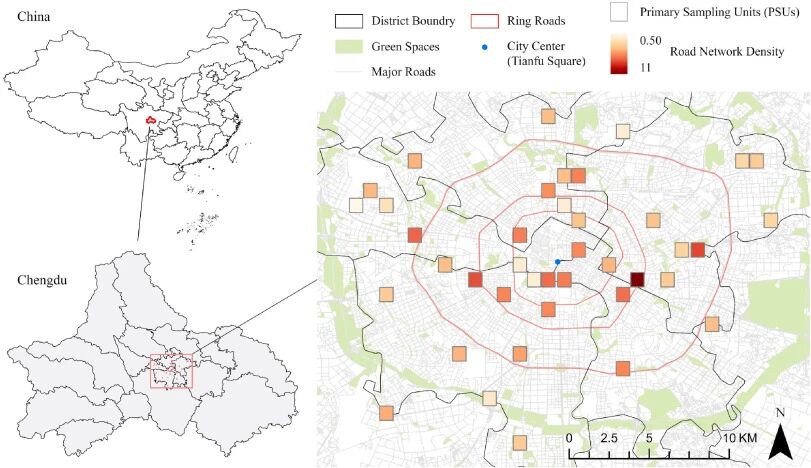
Figure 2. Spatial distribution of the study area and 40 Primary Sampling Units (PSUs) in Chengdu.
The core findings of this study are as follows:
1. Significant intergenerational differences in travel behavior: Younger generations demonstrate a higher reliance on automobiles; however, when controlling for equivalent socioeconomic resources, they exhibit the largest increase in the probability of active travel. Data indicate that the active travel share among the cohort aged 40 and above is significantly higher than that of the 18–40 age group, with the lowest prevalence observed among those aged 26–30. Simultaneously, younger individuals face longer commutes and possess higher car ownership and dependency rates. This, however, does not imply that younger generations have an "innate preference for driving." Standardization and decomposition analyses reveal that when assigning younger individuals socioeconomic characteristics comparable to those of the older generation, the probability of selecting active travel increases significantly, with the most substantial growth (20.8%) observed in the 18–25 age group. This suggests that automobile dependency among the youth is primarily driven by constraints of objective reality rather than intrinsic preferences.
2. Intergenerational differences are co-driven by life-cycle factors and cohort effects. Decomposition analysis reveals that intergenerational disparities in active travel are primarily determined by two categories of factors: life-cycle effects (e.g., income, car ownership, household size, and residential location) and cohort effects (differences in environmental perception and decision-making preferences across generations). These factors interact, exerting the most significant influence on the 18–25 age cohort, thus identifying them as the pivotal demographic for urban green mobility transitions.
3. Multiple factors jointly constrain the choice of active travel. Beyond generational and socioeconomic variables, the study identifies several critical constraints: longer commute times and the possession of a car or driver's license correlate with a lower probability of active travel; conversely, concerns regarding air quality, homogenization of the residential environment, and insufficient pedestrian/cycling infrastructure inhibit walking and cycling behaviors. In contrast, residential diversity and well-developed slow-traffic systems significantly enhance the propensity for active travel. Notably, even under living conditions similar to those of the youth, older cohorts maintain higher rates of active travel, reflecting behavioral inertia formed during the era when cycling was the predominant mode of transport.

Figure 3. Structural Equation Model (SEM) results for the direct effects on active travel modes.
Amid accelerating urban motorization and the pressing need for low-carbon transitions, this study demonstrates that intergenerational differences in travel behavior are not immutable; rather, they serve as crucial entry points for precise urban planning interventions. Younger generations do not inherently reject green mobility; they require an urban environment that is more accommodating and adaptable to their specific needs. When urban spaces are configured to satisfy the behavioral requirements of diverse generations, sustainable mobility emerges as a natural choice.
This research not only fills a gap in the study of mechanisms underlying intergenerational active travel but also provides a scientific basis for transport transformation and healthy city development in rapidly developing cities across China and globally. Future progress necessitates a deeper understanding of intergenerational mobility logic to construct more livable, low-carbon, and human-centric urban transport systems.
Professor Guan Chenghe, Co-Founding Director of the Shanghai Key Laboratory of Urban Design and Urban Science (LOUD), notes that the collaboration between LOUD and the Harvard John A. Paulson School of Engineering and Applied Sciences (SEAS) exemplifies a long-term, stable international academic partnership. This study leverages high-quality longitudinal data derived from the Chengdu survey database, curated by Harvard’s China Project on Energy, Economy, and Environment. Building on this foundation, LOUD and SEAS continue to pursue methodological innovations in urban science, resident behavior research, and sustainable development, jointly constructing an interdisciplinary research network. To date, this collaboration has yielded a series of significant research outcomes, including five SCI/SSCI articles published in journals such as the International Journal of Sustainable Transportation, Earth’s Future, Transportation Research Part D: Transport and Environment, and the Journal of Transport and Land Use.
As an extension of this research agenda, the team officially launched the third wave of longitudinal tracking in 2026. Building upon the framework of the previous rounds (2005 and 2016), this survey focuses on the rise of digital platform-based mobility in the post-pandemic era, the continuous evolution of urban spatial structures, and the profound impacts of emerging issues such as artificial intelligence and shared mobility on travel behavior, while further deepening intergenerational comparative analysis. This ongoing research effort aims to provide a more systematic, long-term empirical basis for understanding low-carbon transport transitions in Chinese cities.
Professor Zhong Haotian, the study's corresponding author from the School of Public Administration at Renmin University of China, states that this research represents one of the outcomes of nearly a decade of collaboration with Professor Guan Chenghe at NYU Shanghai and the Harvard team. "I have always believed in the unique value of interdisciplinary research," he remarks. "In this study, the Harvard team’s deep accumulation in energy and environmental policy, the NYU Shanghai team’s expertise in urban science and spatial analysis, and my training in quantitative methods for public policy created effective synergies. This allowed us to explore the dual theoretical and practical issue of generational differences in urban mobility in China from the intersectional perspectives of demography, behavioral science, and urban planning. This experience further affirms that understanding the sustainable development challenges facing Chinese cities requires both a foundation in local experience and continuous dialogue with the global academic community."
This study was supported by the Shanghai Foundation for Nature and Health, the Pudong Pearl Program for Leading Talents, the Shanghai Higher Education Distinguished Professor (Oriental Scholar) Program, the Overseas High-Level Young Talents Recruitment Program, the Winston Foundation, the NYU Spring 2022 Climate Change Initiative Seed Fund, the National Natural Science Foundation of China, and the Shanghai Municipal Education Commission (AI-Driven Research Paradigm Reform and Disciplinary Empowerment Key Project).
Rfeference:
Guan, C., Zhong, H., Zhou, Y., Li, Y., Zhang, B., Chen, Z., Srinivasan, S., & Nielsen, C. P. (2026). Generational differences in active travel: Estimation, decomposition, and policy implications. Applied Geography, 191, 103997. https://doi.org/10.1016/j.apgeog.2026.103997
- 78 views